Feed on
Posts
Comments

Tag Archive 'Wired'

Memory

Scientists have come close to the possibility of erasing a one-month-old guinea pig’s memories. A protein called α-CaMKII is involved in the storing and regaining of memory.

In particular, researchers increased the levels of this protein at the moment when the guinea pigs remembered the pain consequent to a shock. This increase caused dissipation of the memory connected to the shock, and not just temporarily. The memory seems to be completely lost, as if the fact had never happened. Possible applications of this research are seen in overcoming memories of painful traumas.

Apart from the risk of engineering soldiers who can commit any brutality and forget it chemically, this approach to traumatic memories is a mechanical type without a holistic vision of human beings. The idea is still about having a war against something, as with medicine (“the war against cancer”, against microorganisms, etc.) instead of becoming aware of it.

Memories and traumas enter every cell of the body, and I have an impression that it will probably be possible to inhibit access to a certain memory, but it will not remove its energetic charge in the person. The extreme precision of awareness can act in a way that memories are not removed but are integrated into wider acceptance which becomes part of our experience and growth.

(continua…)

Read Full Post »

Are bloggers a new elite?

Wired author Ryan Singel wrote an article about the Huffington Post “being accused of slimy business practices by a handful of smaller publications who say the site is unfairly copying and publishing their content.” Singel quotes Moser, an editor at alternative weekly Chicago Reader, saying:

If the future of journalism – which everyone keeps telling me The Huffington Post represents – is a bunch of search-engine optimization scams, we have bigger problems than Sam Zell’s bad investment strategies.

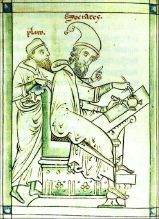
Let me quote Plato in Phaedrus:

Socrates: At the Egyptian city of Naucratis, there was a famous old god, whose name was Theuth; the bird which is called the Ibis is sacred to him, and he was the inventor of many arts, such as arithmetic and calculation and geometry and astronomy and draughts and dice, but his great discovery was the use of letters. Now in those days the god Thamus was the king of the whole country of Egypt; and he dwelt in that great city of Upper Egypt which the Hellenes call Egyptian Thebes, and the god himself is called by them Ammon. To him came Theuth and showed his inventions, desiring that the other Egyptians might be allowed to have the benefit of them; he enumerated them, and Thamus enquired about their several uses, and praised some of them and censured others, as he approved or disapproved of them. It would take a long time to repeat all that Thamus said to Theuth in praise or blame of the various arts. But when they came to letters, This, said Theuth, will make the Egyptians wiser and give them better memories; it is a specific both for the memory and for the wit. Thamus replied: O most ingenious Theuth, the parent or inventor of an art is not always the best judge of the utility or inutility of his own inventions to the users of them. And in this instance, you who are the father of letters, from a paternal love of your own children have been led to attribute to them a quality which they cannot have; for this discovery of yours will create forgetfulness in the learners’ souls, because they will not use their memories; they will trust to the external written characters and not remember of themselves. The specific which you have discovered is an aid not to memory, but to reminiscence, and you give your disciples not truth, but only the semblance of truth; they will be hearers of many things and will have learned nothing; they will appear to be omniscient and will generally know nothing; they will be tiresome company, having the show of wisdom without the reality.

Nobody challenges the importance of letters in our world any more, not even philosophers who use them for elaborating their thoughts. Socrates was not an ordinary philosopher, but a wise and enlightened man who reached spiritual heights beyond conceptual thoughts.

(continua…)

Read Full Post »

Information highways and speed. Chrome for “more,” “new” and “amazing” Web applications

According to several journalists and bloggers, it seems that the world expansion of Internet broadband would be almost the answer to the world’s problems, involving the right to knowledge, overcoming the digital divide, and the opportunity of spreading human rights.

Is the high-technology version of the same message, of the need to “civilize” the world through Western values and to believe that bringing the market system everywhere will bestow welfare and comfort to everybody? Countries which still havn’t “reached” our standards are called “developing,” as it was unavoidable that they would have to traverse a similar path.

The race for larger bandwidth discriminates between who does and doesn’t have it and affects the development of websites and software which are more and more complex and bandwidth-greedy. Software downloads and updates are quite “heavy”: just think about antivirus updates or operating systems, or the “heaviness” of websites like Facebook.

Often myself being in countries where there is no fast connection to the Net, it becomes impossible to update the operating system and sometimes even to do ordinary activities. My blog itself, quite simple in its architecture, is very slow to initialize with an ordinary connection through a modem. In the good old times in the mid-80s I could let up to five people work at the same time with Unix with terminals through a very humble Intel 8086 processor.

The more the bandwidth expands, the more the Net goes towards the visual and risks seeming like a hyper-TV with a predominance of videos and virtual environments to immerse in, evermore hungry of speed and resources. We get further away from narrative to favor disconnected fragments of information; we get further from words and from a path which goes in depth.

(continua…)

Read Full Post »

Echoes of a global tribalism

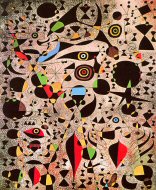
Mirò. Ciphers & Constellations in Love with a Woman

Just before the spread of the Internet, around 1995, we experienced the mobile phone boom in Italy, two media which have transformed our lives. One of the first things I noticed with the advent of the mobile was the transformation of our inner relationship with the territory.

People weren’t “there” anymore where they were physically, but in some other place. Human beings have always inwardly estranged themselves from reality, getting lost in thought, distracted by their mental convolutions, but with mobiles, “not being there” took on a more physical connotation. In the beginning it was amazing to look at people walking alone on the street talking through earphones and gesturing.

Walking in the streets will never be the same as before any more. Our relationship with the “here and now” has got further distanced. At that time I observed how mobiles changed the way people related with each other.

I am used to giving dinner parties at home for several friends. People connect between themselves through long talks and we stay together till late. A sort of collective energy field is created that frequently brings depth to a friendship which was just sensed between people who knew each other less.

(continua…)

Read Full Post »

Mechanisms, mysticism and Amazon Mechanical Turk

<h1><a xhref="http://www.indranet.org/?attachment_id=66">Bureaucrat and Sewing Machine</a></h1>

Human beings have always felt the need to give themselves to something bigger than their individualities: to art, to love, to a cause, to truth, to a guru, to God. When we devote ourselves to something bigger, we transcend ourselves, we go beyond our little narcissistic ego who would always like to be the center of attention. Dedication annihilates a part of ourselves and at the same time it lifts us up to another state of being.

We give ourselves, we trust and we nullify ourselves into technology. We are religiously devoted to the objects of technology, which absorb most of the time of an increasing number of people. As McLuhan wrote, “By continuously embracing technologies, we relate ourselves to them as servomechanisms.”

(continua…)

Read Full Post »

Attribution-NonCommercial-NoDerivs 3.0
This work is licensed under a Attribution-NonCommercial-NoDerivs 3.0.