
 [en]
[en]
The attachments to theories, points of view and dogmas are used to satisfy our need of certainty and to escape confrontation with the void. Often I ask myself how ideologies and dogmas can stand the test of time even though they are so often full of holes.
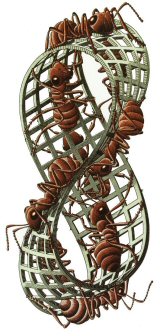
I noticed that among the various mechanisms commonly used, ideologies tend to implement auto-referential processes to defend themselves from criticisms, whereas the criticisms themselves strengthen the ideologies.
Strengthen today, strengthen tomorrow, and the day after that fundamentalisms are born.
[/en][it]
Gli attaccamenti a teorie, punti di vista e dogmi vengono usati per soddisfare il nostro bisogno di certezza e per non sentire il vuoto. Mi sono chiesto spesso come facciano le ideologie e i dogmi a resistere nel tempo nonostante spesso facciano buchi da tutte la parti.
Ho notato che tra i vari meccanismi utilizzati, le ideologie tendono ad implementare dei processi autoreferenziali per difendersi dalle critiche, dove le critiche stesse rafforzano l'ideologia.
Rafforza oggi rafforza domani, si creano i fondamentalismi.
[/it]
[en]
The unending ego activity would do anything to preserve itself. The mind tends to define a unity between its scattered parts by constructing an ego and an identity with well defined traits. The mind protects itself from life’s impermanence and from our illusory personality, identifying itself with its own certainties. The ego unconsciously knows itself to be a construction without firm basis, merely created by concepts and internal self images; this fragility wants to be strengthened somehow.
The attachments to theories, points of view and dogmas are used to satisfy our need of certainty and to escape confrontation with the void. Therefore the human race has created ideologies and models that "put the world in order" and protect ourselves from the unknown, from our own doubts and from the anxiety of not-knowing.
Often I ask myself how ideologies and dogmas can stand the test of time even though they are so often full of holes. I noticed that among the various mechanisms commonly used, ideologies tend to implement auto-referential processes to defend themselves from criticisms, whereas the criticisms themselves strengthen the ideologies. Strengthen today, strengthen tomorrow, and the day after that fundamentalisms are born.
For instance, in religions, criticisms are considered to be a lack of faith or even influenced by the devil, strengthening in this way the validity of the dogma. If there is an evil force then its even more important to be on the good side.
Psychoanalysis created the mechanism of psychological resistance. If anybody doubts the validity of analysis, this is written off as a psychological resistance to the confrontations of analysis, so it validates the model even more.
Technology, though not constituting an ideology in the classical sense, is a thought form that reinforces itself with the ideas of progress and the achievement of a better life through its gadgets. Those who are against this are against progress and a better quality of life.
Communism defends its ideology against critics by regarding them as "enemies of the people, capitalists, imperialists", while capitalism defends itself against critics by considering them to be "enemies of freedom”, “communists” or even “terrorists". In both cases the existence of opposition, real or imagined, serves only to support ones own cause.
Critics of feminism can be regarded as chauvinists and misogynists, or having "problems with the feminine", strengthening the need for feminist ideas.
In religions and in ideologies, the mechanisms of conversion and conviction fortify the system. The more people are convinced, the more our doubts will be quelled. Probably there are many more "isms" and doctrines that use similar mechanisms that will be interesting to deconstruct.
Although the Heisenberg uncertainty principle has been demonstrated and the Gödel theorem tells us that a complex formal system can't be all-embracing, our attachments to ideas don’t die easily, because would bring with them the disaster of losing the sense of identity that we derive from our attachment to the various ideologies. Even faith that should be according to Alan Watts "first of all openness, an act of trust in the unknown" becomes a closed dogma that reduces the whole to a small thing.
The explanatory principle will save you from the fear of the unknown. I prefer the unknown. John Lilly
At the level of concepts and ideas, we focus on meanings, sometimes even looking for meanings behind meanings. This searching for meaning is like pursuing words through the dictionary – one word is explained by others words, which are explained by others, and so on. But a meaning is nothing in itself; it has value only in relation to other meanings. Moving from concept to concept, each created by the one before, is a chase which wastes time and energy. Seen in this way, meanings resemble samsara, a word implying the circular motion of a constantly turning wheel. We can never be free until we realize the ultimate uselessness of pursuing this cycle. When we see that we do not have to assign meanings to anything, when we allow things to be simply as they are, we discover in them their instrinsic nature. Tarthang Tulku. Openness Mind. Self-Knowledge and Inner Peace Through Meditation. Dharma Publishing. Berkeley. 1978
[/en][it]
L'attività incessante dell'ego fa di tutto per mantenersi in vita. La mente tende a definire un'unità tra le sue parti sconnesse costruendo un ego e un'identità con delle peculiarità ben definite. La mente si protegge dall'impermanenza della vita e dalla nostra illusoria personalità identificandosi nelle proprie certezze. L'ego sente inconsciamente di essere una costruzione senza solide basi, in quanto creato dai concetti e dalle immagini interiori di se stessi; questa fragilità vuole essere rafforzata in qualche modo.
Gli attaccamenti a teorie, punti di vista e dogmi vengono usati per soddisfare il nostro bisogno di certezza e per non sentire il vuoto. Quindi si inventano le ideologie e i modelli che "mettono il mondo in ordine" e ci proteggono dall'ignoto, dai nostri stessi dubbi e dall'ansia del non-sapere.
Mi sono chiesto spesso come facciano le ideologie e i dogmi a resistere nel tempo nonostante spesso facciano buchi da tutte la parti. Ho notato che tra i vari meccanismi utilizzati, le ideologie tendono ad implementare dei processi autoreferenziali per difendersi dalle critiche, dove le critiche stesse rafforzano l'ideologia. Rafforza oggi rafforza domani, si creano i fondamentalismi.
Ad esempio, nelle religioni le critiche vengono considerate come mancanza di fede o addirittura essere influenzati dal diavolo, rafforzando così la validità del proprio dogma. Se c'è il male è ancora più importante stare dalla parte del bene.
La psicoanalisi ha inventato il mecanismo della resistenza all'analisi. Se qualcuno mette in dubbio la validità dell'analisi è una resistenza psicologia ad essa e quindi avvalora ancora di più il modello.
La tecnologia, pur se non una idelogia in senso classico è una forma di pensiero che si autorafforza con l'idea di progresso e di una vita migliore attraverso i suoi prodotti. Chi si contrappone è contro lo sviluppo e la qualità della vita.
Il comunismo si difende dai critici considerandoli "nemici del popolo, imperialisti" mentre il capitalismo si difende dai critici considerandoli "nemici della libertà, comunisti o addirittura terroristi". In entrambi i casi l'importanza di contrapporsi e di sostenere la propria causa diventa più pressante e l'opposizione stessa rafforza l'ideologia.
Le critiche al femminismo possono essere voste come maschilismo e misoginia, dando forza alla necessita delle idee femministe.
Nelle religioni e nelle ideologie il meccanismo della conversione e della convizione rafforza il sistema. Più gente viene convinta, più i nostri dubbi saranno placati. Probabilmente vi sono altri "ismi" e dottrine che usano meccanismi simili, sarebbe interessante decostruirli.
Nonostante si sia dimostrato il principio di indeterminazione di Heisenberg e il teorema di Gödel ci dice che un sistema formale complesso non può essere esaustivo, gli attaccamenti alle idee sono duri a morire, in quanto porterebbero con sè la catastrofe delle identità a cui ci aggrappiamo più tenacemente. Anche la fede che dovrebbe essere secondo Alan Watts "anzitutto, apertura: un atto di fiducia nello sconosciuto" diventa una chiusura entro dogmi che limitano il tutto a… ben poco.
Il principio esplicativo ti salverà dalla paura dello sconosciuto. Io preferisco lo sconosciuto. John Lilly
Al livello dei concetti e delle idee, ci focalizziamo sui significati, qualche volta addirittura cercando i significati che stanno sotto ai significati. Questa ricerca del significato è come la ricerca delle parole in un dizionario – una parola viene spiegata da altre parole, le quali a loro volta vengono spiegate da altre e così via. Ma un significato non è nulla in sè; ha valore solo in relazione ad altri significati. Spostandosi da un concetto all'altro, ognuno creato dal precedente, è un inseguimento che spreca tempo ed energia. In questa ottica, i significati ricordano il samsara, dove le parole implicano il moto perenne circolare di una ruota. Non potremo mai essere liberi fino a che non realizziamo l'inutilità del perseguire questo ciclo. Quando realizziamo che non c'è bisogno di assegnare significati a qualsiasi cosa, quando lasciamo che le cose semplicemente siano come sono, scopriamo la loro reale natura. Tarthang Tulku. Openness Mind. Self-Knowledge and Inner Peace Through Meditation. Dharma Publishing. Berkeley. 1978
[/it]