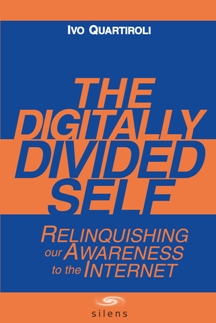
 The Digitally Divided Self: Relinquishing our Awareness to the Internet is on Amazon.
ISBN 9788897233008
274 Pages – Format: 6″ x 9″ – $17.90 (discounted on Amazon)
It is nearly half a century since Marshall McLuhan pointed out that the medium is the message. In the interim, digital technologies have found an irresistible hook on our minds. With the soul’s quest for the infinite usurped by the ego’s desire for unlimited power, the Internet and social media have stepped in to fill our deepest needs for communication, knowledge and creativity – even intimacy and sexuality. Without being grounded in those human qualities which are established through experience and inner exploration, we are vulnerable to being seduced into outsourcing our minds and our fragile identities.
Intersecting media studies, psychology and spirituality, The Digitally Divided Self exposes the nature of the malleable mind and explores the religious and philosophical influences which leave it obsessed with the incessant flow of information.
I am deeply touched and extremely grateful to the people who took the time to read, support and endorse The Digitally Divided Self. Being my first English book, and basically self-published, I didn’t expect to receive many reviews, much less from such leading thinkers and writers – nor such positive responses.
It was also a surprise to find common interests around eastern spirituality with so many people into technology and media. This makes me hopeful for an evolution of the information society – from chasing external stimulation to inner explorations and silence.
Detailed table of contents, introduction and chapter 1.
Order on Amazon.
Praise for Digitally Divided Self
“Quartiroli’s The Digitally Divided Self is a must read for anyone seeking to understand the ever-increasing hegemony of the digital world in the individual psyche. Drawing on diverse fields and traditions, the author analyzes numerous mechanisms by which IT separates us from ourselves. Readers stand to benefit from such an understanding that is a prerequisite for mounting a defense of one’s individuality.” —Len Bracken, author of several novels and the biography Guy Debord—Revolutionary
“With great insight, Ivo Quartiroli captures the subtle as well as the gross impact that media use has on our individual and collective psyches. The challenge before all of us is how to adapt to the new technology in a healthy way that allows us to retain our essential humanity. He offers us a solution born of his experience and confirmed by neuroscience. This is a must read.” —Hilarie Cash, PhD, co-founder of reSTART: Internet Addiction Recovery Program
“It is difficult to offer a spiritually based critique of today’s network culture without sounding like a nostalgic Luddite crank. Immersed in the tech, but also in various meditative traditions, Ivo Quartiroli is the perfect person to offer integral wisdom-tech with clarity and bite.” —Erik Davis, author of Techgnosis and Nomad Codes: Adventures in Modern Esoterica.
“Aware of the profound and rapid psychological and social metamorphosis we are going through as we ‘go digital’ without paying attention, Ivo Quartiroli is telling us very precisely what we are gaining and what we are losing of the qualities and privileges that, glued as we are to one screen or another, we take for granted in our emotional, cognitive and spiritual life. This book is a wake-up call. Steve Jobs and Bill Gates should read it.” —Derrick de Kerckhove, Professor, Facoltà di sociologia, Università Federico II, Naples, former Director of the McLuhan Program in Culture and Technology.
“The Digitally Divided Self alerts us about the insidious dangers of our growing dependence on Information Technology. Ivo Quartiroli warns us that Internet can easily develop into an addiction that undercuts our connections with nature, with other people, and with our deeper inner reality. The spiritual nourishment coming from genuine relationships is then replaced by the empty calories of fake relationships, with the resulting deterioration of our personal and social lives. Using an incisive style, Ivo Quartiroli can be provocative, iconoclastic, at times exaggerated, but never boring. Behind each observation there are pearls of wisdom that are guaranteed to make you think.” —Federico Faggin, designer of the microprocessor.
“Global culture is not only the latest step in the human evolutionary journey. It is also, as Ivo Quartiroli shows in The Digitally Divided Self, a critical opportunity to apply non-Western techniques of awareness to ensure healthy survival in the 21st century.” —Michael Heim, author of The Metaphysics of Virtual Reality, Virtual Realism, and Electric Language.
“Question the merits of technology in the past and you’d be called a Luddite. But now technologists are leading the way toward a new, more balanced view of our gadget-driven lives. Drawing from his fascinating expertise in computer science and spirituality, Ivo Quartiroli presents a compelling critique of the corrosive impact of the Net on our humanity. It’s a warning we must heed.” —Maggie Jackson, author of Distracted: The Erosion of Attention and the Coming Dark Age.
“A profoundly premonitory vision of the future of the 21st century, The Digitally Divided Self unlocks the great codes of technological society, namely that the very same digital forces that effectively control the shape and direction of the human destiny are also the founding powers of a new revolution of the human spirit.” —Arthur Kroker, author of The Will to Technology and Canada Research Chair in Technology, Culture and Theory.
“People today, especially young people, live more on the Internet than in the real world. This has subtle and not-so-subtle effects on their thinking and personality. It is high time to review these effects, to see whether they are a smooth highway to a bright interconnected future, or possibly a deviation that could endanger health and wellbeing for the individual as well as for society. Ivo Quartiroli undertakes to produce this review and does so with deep understanding and dedicated humanism. His book should be read by everyone, whether he or she is addicted to the Internet or has second thoughts about it.” —Ervin Laszlo, President, the Club of Budapest, and Chancellor, the Giordano Bruno Globalshift University.
“The Mind-Body Split is a pervasive condition/affliction in the developed world, wholly un-recognized; yet fundamental to the great worldwide problems of health, environment, and economic inequity. Ivo Quartiroli’s Digitally Divided Self masterfully examines the effects of the insulated digital experience on the mind and the body self: exacerbating illusions and the Mind-Body Split; and contrasts it to the processes of self-discovery, growth, and healing: true inter-connectedness with nature, each other, and our selves. If the digital age is to solve our real problems, rather than create them, it will be with the knowledge contained in The Digitally Divided Self. Well done!” —Frederic Lowen, son of Alexander Lowen, Executive Director, The Alexander Lowen Foundation
“Ivo Quartiroli here addresses one of the most pressing questions forced upon us by our latest technologies. In disturbing the deepest relations between the user’s faculties and the surrounding world, our electric media, all of them without exception, create profound disorientation and subsequent discord, personal and cultural. Few subjects today demand greater scrutiny.” — Dr. Eric McLuhan, Author and Lecturer
“The internet is an extension of our central nervous system. When you operate a computer, you are extending yourself, through its interface, potentially all over the world, instantaneously. Extending yourself in such a disembodied, discarnate fashion only further entrenches your separateness, your ego self. In contrast, the introspective freeing from the physical through meditation also has the effect of creating a discarnate, disembodied state. That state is one that is progressively less identified with the ego self. This is the dichotomy that Ivo Quartiroli explores in The Digitally Divided Self. This book is well worth investigating.” —Michael McLuhan
“We should all be asking the questions Ivo Quartiroli asks in this bold and provocative book. Whatever you think right now about technology, The Digitally Divided Self will challenge you to think again.” —William Powers, author of the New York Times bestseller Hamlet’s BlackBerry
“It isn’t easy to find an informed and critical look at the impact of digital media practices on human lives and minds. Ivo Quartiroli offers an informed critique based in both an understanding of technology and of human consciousness.” —Howard Rheingold, author of The Virtual Community and Smart Mobs.
“Ivo Quartiroli is mining the rich liminal territory between humans and their networks. With the integrity of a scientist and the passion of artist, he forces us to reconsider where we end and technology begins. Or when.” —Douglas Rushkoff, Media Theorist and author of Cyberia, Media Virus, Life, Inc. and Program or Be Programmed.
“You might find what he writes to be challenging, irritating, even blasphemous and sacrilegious. If so, he has proven his point. The Internet, Ivo suggests, might just be the new opium of the masses. Agree with him or not, no other book to date brings together the multitude of issues related to how the seductions of technology impinge upon and affect the development of the self and soul.” —Michael Wesch, Associate Professor of Digital Ethnography, Kansas State University
“The Digitally Divided Self is a refreshing look at technology that goes beyond the standard, well-worn critiques. Ivo Quartiroli charts new territory with a series of profound reflections on the intersections of computer science, psychology and spirituality.” —Micah White, Senior Editor at Adbusters magazine.
Detailed table of contents, introduction and chapter 1.
Order on Amazon.
Table of Contents
Chapter 1: From Awareness of technology to technologies of Awareness .. 1
Chapter 2:“It’s only a tool” .. 17
Chapter 3: The Roots of It .. 39
Chapter 4: The Digitization of Reality .. 53
Chapter 5: Intimacy and Sexuality.. 73
Chapter 6: Commoditizing and Monetizing.. 89
Chapter 7: Politics, Participation and Control .. 97
Chapter 8: Come together: the Rise of Social networks.. 115
Chapter 9: Digital Kids ..125
Chapter 10: Literacy and the Analytical Mind.. 133
Chapter 11: Lost in the Current .. 143
Chapter 12: The Digitally Divided Self.. 165
Chapter 13: The Process of Knowledge .. 189
Chapter 14: Upgrading to Heaven .. 205
Chapter 15: Biting the Snake.. 223
Appendix: The People of Contemporary It and what Drives them.. 233
Introduction
Like many people nowadays, much of my personal and professional life is related to technology: I use the Internet for keeping the connection with my work projects and friends wherever I am in the world. I published the first book in Italy about the Internet. I run a blog and a Web magazine, do my investments online, shop on the Net, do interviews by email and Skype, and have even indulged in cybersex. Right now I’m in Asia developing this book – which is full of references to Web articles, blogs and material found only on the Internet – with online support: an editor and writing coach in California, copy editor in India, book designer in Italy, and a printing and distribution service with multiple locations in USA. My life is immersed in the digital loop.
I have been involved in IT since I was a student. As I learned meditation and explored spiritual paths, I developed an inner observer and discovered states beyond the mind. Thus, I found myself going back and forth between processing consciousness and information. Slowly my focus has shifted from what we can do with technology to what technology does to us. As a first-hand explorer, I’ve observed the subtle changes of our massive use of the Net.
Just as a spiritual researcher can go beyond the mind only after having observed and mastered it, it is necessary to enter the digital world to step beyond it. We can’t become aware of its effects without being engaged in it. Since digital technology is unavoidable now, we need to master it without becoming lost in it, using its tools with our full awareness.
In this time, the intensification of mental inputs is a phenomenon that must be kept in balance. Our contemporary culture does not acknowledge anything beyond the mind, but in other traditions the mental world is just one of the aspects of our wholeness. In the West a sort of Cartesian “pure thinking” has been given priority. Although the mind is the best-known organ of thought, it is not the only cognitive modality. Nervous systems have been discovered both in the heart and in the belly, and the global awareness that can be accessed by spiritual practitioners is pervasive and non-localized. Yet these modalities cannot be represented digitally, so they are relegated to the sidelines.
Our technological society militates against uninterrupted conscious attention. Several authors have documented the effects of IT on attention, literacy and intellectual skills. It also intrudes on the silent time needed to be aware of inner transformations. We don’t realize we have become servomechanisms of IT – precisely because IT has weakened the inner skills of self-understanding. Shrinking of the rich range of human qualities to privilege only those which can be represented and operated digitally arises from the nature of the ego-mind and our particular Western history which has engendered – then valued – mental representations of reality. My focus here is to understand why the mind can be lured by the magic of the tools, while forgetting the person who is using them.
We believe we are empowered individually and politically as we post articles on our blogs and participate in social networks. In actuality, we feed the machine with our “user-generated content” which becomes candy for advertisers who then design ads based on what we say on Twitter, Facebook, and even our emails.
Jumping from information to self-understanding is necessary if we are to regain real freedom, a freedom from conditioning of our mind and the manipulation by information – whether self-created or from external sources. We mistake the transmission of gigabytes of data for freedom.
In our advanced technological society there is a reticence to acknowledge the inner, spiritual or metaphysical dimensions of life. What cannot be calculated – which is, thereby, “not objective” – is considered unworthy of investigation. Even more strongly denied is the relationship between technology and the impact on our psyche. Technophiles declare that it’s only a tool, as if our psyche could remain untouched by continuous interaction with digital media, and as if we could control its impact on us. We can indeed be in control of digital media – but only after we become fluent in those cognitive modalities which can’t be reached by such media.
To be unaffected by digital media, we need a Buddha-like awareness with sustained attention, mindfulness and introspection. Yet these very qualities which are needed to break out of the automated mind are especially difficult to access when we are drowning in information – information that is predominantly ephemeral and transient, and which lacks a broader narrative. Awareness is what gives meaning and depth to information, but for awareness to expand we need to empty our mind. A story will illustrate this. A university professor approached a master to learn about Zen. Tea was served, but when the cup was full, the master did not stop pouring. The cup, like the professor’s mind with its concepts and positions, was full. It must first be emptied to understand Zen. So, too, for the digital world.
The world over, people using the Internet click on the same icons, use the same shortcuts in email and chats, connect with people through the same Facebook modalities. This is the globalization of minds. In the process of the digitization of reality, regardless of content, we use predominantly the same limited mental channels and interact with the same tools. We bring the same attitudes, gestures and procedures to working, dating, shopping, communicating with friends, sexual arousal, and scientific research. And most of these activities are impoverished by this phenomenon. Everything is seen as an information system, from the digitization of territory (like Google Earth and augmented realities software) to our biology.
Judeo-Christian culture places nature and the world of matter at man’s disposal. Acting on them is a way to garner good deeds and regain the lost perfection of Eden. In this culture that has considered miracles as proof of the existence of God, we have developed technologies that resemble the miraculous and the divine. We are compelled to welcome the advent of new technological tools with the rhetoric of peace, progress, prosperity and mutual understanding.
The telegraph, telephone, radio, TV and other media have been regarded as tools for democracy, world peace, understanding and freedom of expression. The Internet is just the latest in a succession of promising messiahs. Yet we don’t have more democracy in the world. In fact, big media and big powers are even stronger, while freedom of expression has ceded to control by corporations and governmental agencies. The Internet, like TV, will be entertaining, dumbing people in their own separate homes where they will be unable to question the system. The Internet might already be the new soma for a society experiencing economic and environmental degradation. But with the huge economic interests connected to it, criticizing its effect is akin to cursing God.
Many technological developments appeal to people because they answer psychological and even spiritual needs – like the quests for understanding and connection with others. Already digital technology has taken charge of truth and love – the drives which are distinctly human. Those primordial needs have been addressed, on the mental level, with information. Reflected only at that level, our soul is left empty with craving for the real qualities, and our mind is left restless, craving more information and chasing after satisfaction in vain.
The need to extend our possibilities through technology derives from the need to recover parts of ourself that were lost during the development of our soul – the states of sharp perception, fulfillment, and peace. Information technology (IT) also satisfies our ancient drives for power and control, even giving us several options with a simple click or touch of a finger.
The endless multiplication of information can keep the ego-mind busy – and thus at the center of the show. IT is the most powerful mental “pusher” ever created, feeding the duality of the ego-mind (which is symbolically mirrored by binary technology). More than TV whose attractions are framed between the beginning and ending time of a show, the Internet, video games, and smartphones have no structural pauses or endings. Hooked on a “real-time” stream of information, they take us farther away from both the real and the appropriate time frames.
The computer charms us by reflecting our mind on the Net. Like Narcissus, we mistake the reflected image and enter a closed loop, charmed by our reflection. The Internet, since the beginning, has been considered a technology which could crumble central governments and organizations. Perhaps that forecast was an external projection of what can happen inside us: disturbance of the integration of our psyches.
Meditation helps us recognize that we construct reality and that the mind leads us astray. Meditation is a path back to reality, to truth, to knowing and mastering our minds – instead of mastering the computer as a way to outsource our mind’s skills. It is a way to expand our awareness and join the other global “Net” – of awareness that permeates everything.
Though I am Italian, I am publishing this book for the English market because it is a post-digital book which can be better appreciated in countries where digital culture has spread throughout society. In Italy, one politically powerful tycoon owns most of the media, and uses it to demonize the Net. In that setting, being critical of the Net invokes the accusation of aligning with power to castrate freedom of expression, which is the polar opposite of my intention.
I welcome every medium which expands our chances of expressing ourselves, but I am aware that true self-expression can happen only when there’s a true self, which can hardly be shaped by screen media.
I am grateful to my spiritual teachers who opened new dimensions for my soul in my journey toward awareness, especially the intensity of Osho and the brilliant clarity of A. H. Almaas. I thank my copy editor Dhiren Bahl (www.WordsWay-Copyediting.com) for his painstaking corrections of my English text and my editor David Carr (www.MovingWords.us) for his clarifications and stylistic improvements. I’m grateful to my friends, too many to list here, for the numerous talks bringing together heart and mind in sharing our passion for truth.
Detailed table of contents, introduction and chapter 1.
Order on Amazon.
The Digitally Divided Self: Relinquishing our Awareness to the Internet is on Amazon.
ISBN 9788897233008
274 Pages – Format: 6″ x 9″ – $17.90
It is nearly half a century since Marshall McLuhan pointed out that the medium is the message. In the interim, digital technologies have found an irresistible hook on our minds. With the soul’s quest for the infinite usurped by the ego’s desire for unlimited power, the Internet and social media have stepped in to fill our deepest needs for communication, knowledge and creativity – even intimacy and sexuality. Without being grounded in those human qualities which are established through experience and inner exploration, we are vulnerable to being seduced into outsourcing our minds and our fragile identities.
Intersecting media studies, psychology and spirituality, The Digitally Divided Self exposes the nature of the malleable mind and explores the religious and philosophical influences which leave it obsessed with the incessant flow of information.
I am deeply touched and extremely grateful to the people who took the time to read, support and endorse The Digitally Divided Self. Being my first English book, and basically self-published, I didn’t expect to receive many reviews, much less from such leading thinkers and writers – nor such positive responses.
It was also a surprise to find common interests around eastern spirituality with so many people into technology and media. This makes me hopeful for an evolution of the information society – from chasing external stimulation to inner explorations and silence.
Order on Amazon.
Praise for Digitally Divided Self
“Quartiroli’s The Digitally Divided Self is a must read for anyone seeking to understand the ever-increasing hegemony of the digital world in the individual psyche. Drawing on diverse fields and traditions, the author analyzes numerous mechanisms by which IT separates us from ourselves. Readers stand to benefit from such an understanding that is a prerequisite for mounting a defense of one’s individuality.” —Len Bracken, author of several novels and the biography Guy Debord—Revolutionary
“With great insight, Ivo Quartiroli captures the subtle as well as the gross impact that media use has on our individual and collective psyches. The challenge before all of us is how to adapt to the new technology in a healthy way that allows us to retain our essential humanity. He offers us a solution born of his experience and confirmed by neuroscience. This is a must read.” —Hilarie Cash, PhD, co-founder of reSTART: Internet Addiction Recovery Program
“It is difficult to offer a spiritually based critique of today’s network culture without sounding like a nostalgic Luddite crank. Immersed in the tech, but also in various meditative traditions, Ivo Quartiroli is the perfect person to offer integral wisdom-tech with clarity and bite.” —Erik Davis, author of Techgnosis and Nomad Codes: Adventures in Modern Esoterica.
“Aware of the profound and rapid psychological and social metamorphosis we are going through as we ‘go digital’ without paying attention, Ivo Quartiroli is telling us very precisely what we are gaining and what we are losing of the qualities and privileges that, glued as we are to one screen or another, we take for granted in our emotional, cognitive and spiritual life. This book is a wake-up call. Steve Jobs and Bill Gates should read it.” —Derrick de Kerckhove, Professor, Facoltà di sociologia, Università Federico II, Naples, former Director of the McLuhan Program in Culture and Technology.
“The Digitally Divided Self alerts us about the insidious dangers of our growing dependence on Information Technology. Ivo Quartiroli warns us that Internet can easily develop into an addiction that undercuts our connections with nature, with other people, and with our deeper inner reality. The spiritual nourishment coming from genuine relationships is then replaced by the empty calories of fake relationships, with the resulting deterioration of our personal and social lives. Using an incisive style, Ivo Quartiroli can be provocative, iconoclastic, at times exaggerated, but never boring. Behind each observation there are pearls of wisdom that are guaranteed to make you think.” —Federico Faggin, designer of the microprocessor.
“Global culture is not only the latest step in the human evolutionary journey. It is also, as Ivo Quartiroli shows in The Digitally Divided Self, a critical opportunity to apply non-Western techniques of awareness to ensure healthy survival in the 21st century.” —Michael Heim, author of The Metaphysics of Virtual Reality, Virtual Realism, and Electric Language.
“Question the merits of technology in the past and you’d be called a Luddite. But now technologists are leading the way toward a new, more balanced view of our gadget-driven lives. Drawing from his fascinating expertise in computer science and spirituality, Ivo Quartiroli presents a compelling critique of the corrosive impact of the Net on our humanity. It’s a warning we must heed.” —Maggie Jackson, author of Distracted: The Erosion of Attention and the Coming Dark Age.
“A profoundly premonitory vision of the future of the 21st century, The Digitally Divided Self unlocks the great codes of technological society, namely that the very same digital forces that effectively control the shape and direction of the human destiny are also the founding powers of a new revolution of the human spirit.” —Arthur Kroker, author of The Will to Technology and Canada Research Chair in Technology, Culture and Theory.
“People today, especially young people, live more on the Internet than in the real world. This has subtle and not-so-subtle effects on their thinking and personality. It is high time to review these effects, to see whether they are a smooth highway to a bright interconnected future, or possibly a deviation that could endanger health and wellbeing for the individual as well as for society. Ivo Quartiroli undertakes to produce this review and does so with deep understanding and dedicated humanism. His book should be read by everyone, whether he or she is addicted to the Internet or has second thoughts about it.” —Ervin Laszlo, President, the Club of Budapest, and Chancellor, the Giordano Bruno Globalshift University.
“The Mind-Body Split is a pervasive condition/affliction in the developed world, wholly un-recognized; yet fundamental to the great worldwide problems of health, environment, and economic inequity. Ivo Quartiroli’s Digitally Divided Self masterfully examines the effects of the insulated digital experience on the mind and the body self: exacerbating illusions and the Mind-Body Split; and contrasts it to the processes of self-discovery, growth, and healing: true inter-connectedness with nature, each other, and our selves. If the digital age is to solve our real problems, rather than create them, it will be with the knowledge contained in The Digitally Divided Self. Well done!” —Frederic Lowen, son of Alexander Lowen, Executive Director, The Alexander Lowen Foundation
“Ivo Quartiroli here addresses one of the most pressing questions forced upon us by our latest technologies. In disturbing the deepest relations between the user’s faculties and the surrounding world, our electric media, all of them without exception, create profound disorientation and subsequent discord, personal and cultural. Few subjects today demand greater scrutiny.” — Dr. Eric McLuhan, Author and Lecturer
“The internet is an extension of our central nervous system. When you operate a computer, you are extending yourself, through its interface, potentially all over the world, instantaneously. Extending yourself in such a disembodied, discarnate fashion only further entrenches your separateness, your ego self. In contrast, the introspective freeing from the physical through meditation also has the effect of creating a discarnate, disembodied state. That state is one that is progressively less identified with the ego self. This is the dichotomy that Ivo Quartiroli explores in The Digitally Divided Self. This book is well worth investigating.” —Michael McLuhan
“We should all be asking the questions Ivo Quartiroli asks in this bold and provocative book. Whatever you think right now about technology, The Digitally Divided Self will challenge you to think again.” —William Powers, author of the New York Times bestseller Hamlet’s BlackBerry
“It isn’t easy to find an informed and critical look at the impact of digital media practices on human lives and minds. Ivo Quartiroli offers an informed critique based in both an understanding of technology and of human consciousness.” —Howard Rheingold, author of The Virtual Community and Smart Mobs.
“Ivo Quartiroli is mining the rich liminal territory between humans and their networks. With the integrity of a scientist and the passion of artist, he forces us to reconsider where we end and technology begins. Or when.” —Douglas Rushkoff, Media Theorist and author of Cyberia, Media Virus, Life, Inc. and Program or Be Programmed.
“You might find what he writes to be challenging, irritating, even blasphemous and sacrilegious. If so, he has proven his point. The Internet, Ivo suggests, might just be the new opium of the masses. Agree with him or not, no other book to date brings together the multitude of issues related to how the seductions of technology impinge upon and affect the development of the self and soul.” —Michael Wesch, Associate Professor of Digital Ethnography, Kansas State University
“The Digitally Divided Self is a refreshing look at technology that goes beyond the standard, well-worn critiques. Ivo Quartiroli charts new territory with a series of profound reflections on the intersections of computer science, psychology and spirituality.” —Micah White, Senior Editor at Adbusters magazine.
Order on Amazon.
Table of Contents
Chapter 1: From Awareness of technology to technologies of Awareness .. 1
The Limits of Technology.. 3
What’s Not Computable Isn’t Real .. 4
The Promises of the Early Internet .. 5
From Information Processing to Consciousness Processing.. 6
All in the Digital Mincer .. 7
Technology Can’t be Challenged.. 8
Technology Uses Us .. 10
Feeding the Soul with Bytes .. 11
The Immortal Mind .. 12
Inner Prostheses and Amputations through Technology .. 13
Beyond the Mind.. 14
The Fragility of Beliefs and Information Technology.. 15
Chapter 2:“It’s only a tool” .. 17
Technology is not Questionable .. 18
Knowing through the Body .. 18
Technology “Does” Us .. 19
Technology is a Matter of Life and Death.. 21
Binary and Inner Duality.. 21
Knowing through the Heart.. 22
Our Identity With Tools – from Chimps to Chips .. 25
Reconnecting with the Inner Flow.. 26
From Spectator to Witness .. 28
Inner Holes and Techno-Fills .. 28
Pure Thinking Without the Body.. 30
Tools for Inner Growth.. 31
The Mind Itself is a Medium.. 34
IT Weakens Our Presence .. 36
Constrained to Produce .. 39
Chapter 3: The Roots of It .. 39
Constrained to Produce .. 39
IT was Started by the Bible .. 40
Technology as Returning to the Lost Perfection .. 41
Contradictory Messages Short Circuit the Psyche .. 43
Children of a Lesser God .. 44
Psychological Defenses .. 44
Technology as the Ultimate Savior .. 45
The Nature of the Mind.. 46
Conceptual Debris and Technology as a Holding Agent for the Psyche 47
The Quest for Immortality .. 48
Copying, Improving and Creating Minds.. 50
Chapter 4: The Digitization of Reality .. 53
Data is King .. 55
The Digitization of Territory .. 56
Augmenting Reality .. 57
The Mind as the First Virtual Reality Tool .. 58
The Digitization of Biology .. 59
Analogical Models of Reality .. 64
Our Digital Nervous Systems .. 66
Programming .. 67
Thinking like Software .. 69
Digitizing All Life Events .. 71
Chapter 5: Intimacy and Sexuality.. 73
Eros and the Sexualization of Society .. 74
Cybersex.. 75
The Transformation of Seduction and of Relationship .. 77
Masturbation and Sex Toys.. 78
Orgasm 2.0.. 80
Cybervirgins .. 82
Gender Issues and the Vanishing Male.. 84
Earlier Exposure to Porn.. 85
Desires .. 87
Cybersex as a Tantric Path .. 87
Chapter 6: Commoditizing and Monetizing.. 89
Replacing the Real .. 90
Playing with Feelings .. 90
iMarket .. 92
Brave New World.. 94
Deconstructing Sense and Ethics.. 94
Toward the Denial of Truth .. 95
Chapter 7: Politics, Participation and Control .. 97
The Rulers of Our Psyches .. 98
Governments.. 99
Advertising and Our Attention.. 100
Google .. 101
Wikileaks .. 104
Into Our Digital Persona .. 104
You Can Tell What Somebody is Like by the Company They Keep.. 105
Is the Internet Empowering Us? .. 106
Illusory Participation.. 107
Slacktivism .. 110
The Yogic Geek.. 112
Renouncing the World .. 115
Chapter 8: Come together: the Rise of Social networks.. 115
Renoucing the World .. 115
The Inner Need of Connection and Facebook.. 116
Experiencing for Others to See .. 118
Empathy.. 119
Illusory Contact.. 121
Body/Mind Development in Childhood .. 125
Chapter 9: Digital Kids ..125
Body/Mind Development in Childhood .. 125
Denied Childhood .. 126
Computers in Education .. 127
Lack of Mentors .. 128
Technology as an Answer to Social Fear .. 129
Wired Children.. 130
Sleepless Children .. 132
Chapter 10: Literacy and the Analytical Mind.. 133
Analytical and Critical Skills .. 136
A New Literacy Through eBooks? .. 138
The Reading “Technology” .. 139
Digital Writing .. 140
Communication and the Transformation of Consciousness.. 141
Attend to This! .. 143
Chapter 11: Lost in the Current .. 143
Attend to This! .. 143
Attend to it Now and Forever! .. 145
New is Cool .. 145
Instant Gratification.. 145
Neurological Changes Related to Instant Gratification .. 146
Accepting Emptiness and the Eureka Effect.. 147
Faster and Faster, but just Apparently .. 149
Into the Loop .. 151
Technological Updates and the Right to Silence .. 152
Cogitus Interruptus through Multitasking .. 153
No History, No Narrative, No Past .. 156
Digital and Human Memory.. 157
Addiction.. 158
Awareness of Feelings and Addiction.. 162
Attention .. 165
Chapter 12: The Digitally Divided Self.. 165
Attention .. 165
The Construction of the Self .. 166
Technological Development as a Metaphor of the Psychological One .. 170
Millions of MP3s and the Missing “My Personality” .. 173
Attachment to the Machine .. 173
The Need for Mirroring .. 174
Maternal Feeding and Paternal Limit Setting .. 175
The Sand Castle Crumbles: Toward a Schizoid State.. 176
The Other as Image .. 178
Detaching from the Body .. 179
The Schizoid State is an Ontological Condition .. 181
The Eye, the Ear, and a Global Tribalism.. 181
The Mind as a Medium.. 183
No Identity.. 185
The Reign of Objectivity .. 189
Chapter 13: The Process of Knowledge .. 189
The Reign of Objectivity .. 189
Joining Inner and Outer Knowledge .. 192
Not Knowing.. 195
Words are Second-Best After Silence.. 198
Do We Know with our Brains? .. 200
Externalizing Thinking .. 202
Chapter 14: Upgrading to Heaven .. 205
Creating Consciousness.. 206
Technology as an Ego Maintainer .. 209
IT Beyond Me: Unlinking Ourselves through Technology .. 211
Here and Now.. 213
Devotionally Disappearing into Technology.. 214
The Immortal Mind.. 215
Spiritual Powers through Technology .. 217
Are we Machines? .. 218
The Will to Create Mental Worlds .. 220
Chapter 15: Biting the Snake.. 223
Out of the Loop.. 224
Screen Media vs. Meditation .. 225
Meditation .. 228
IT is basically Counter-Meditative.. 230
Another Maya Layer through Technology .. 231
Charles Babbage.. 233
Appendix: The People of Contemporary It and what Drives them.. 233
Charles Babbage.. 233
Ada Lovelace .. 234
John von Neumann.. 234
Norbert Wiener .. 235
Alan Turing .. 235
Al Gore.. 236
Steward Brand .. 237
Kevin Kelly .. 238
Bill Gates.. 239
Steve Jobs .. 239
Withdrawing into the Mind .. 240
Bibliography .. 241
Index .. 249
Order on Amazon.