
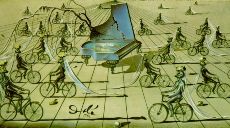
.jpg "Dali The Phenomenon of Ecstasy.jpg") After a series of resistances to Facebook I experimented with the social network in the last few months. The first resistance was about presenting a “self” of mine, the same for all people in my friends’ list. This created some perplexity for me. I like the variety of human beings and have always mixed with people of the most variety: adventurers, hippies, artists, travelers, therapists, entrepreneurs, scholars, rich, poor and creative mixes of those natures. My self, being composed of a mix of different personalities, tends to show different facets of my nature where these can find correspondence. Inevitably, this creates more intimate and personalized relationships but at the same time they are limited by a subset of our personality.
After a series of resistances to Facebook I experimented with the social network in the last few months. The first resistance was about presenting a “self” of mine, the same for all people in my friends’ list. This created some perplexity for me. I like the variety of human beings and have always mixed with people of the most variety: adventurers, hippies, artists, travelers, therapists, entrepreneurs, scholars, rich, poor and creative mixes of those natures. My self, being composed of a mix of different personalities, tends to show different facets of my nature where these can find correspondence. Inevitably, this creates more intimate and personalized relationships but at the same time they are limited by a subset of our personality.
With Facebook and the public profile which widely embraces our personality, I was afraid of not being recognized “for what I am” by some individuals. It reminded me of One, No One, and One Hundred Thousand, the latest novel and a masterpiece of Luigi Pirandello. Basically we are “One,” but for the majority of people we are not “No One,” while in front of the multitude of people who know us, we are “One Hundred Thousand.” We are a different person in the eyes of each person. Without going to the spiritual level where we can say that actually all of us are “nobody” and “everything” at the same time, remaining on the levels of the personality construction and object relationships, Facebook is an interesting experiment.
On the Net we are often anonymous in many spheres: in our Web surfing, in social networks and in forums, we mostly use identities which do not identify us precisely. Facebook is an attempt to reunify the various personalities and to give a center of consciousness to the fragmentation of the online personality. It is an attempt to overcome – even though limited to the digital area – the various object relationships. Facebook can represent an evolution of the adolescent search of one’s own personality, a stage when there are attempts to give ourselves an identity through experimenting with life and people and often hiding behind anonymity.
So, here I am with my “real me” on Facebook, the same in front of everybody, unifying the pieces of my history and therefore the pieces of my psyche. What will it be like, this public “me”? As a lowest common multiple where my relationships and human qualities can be creatively expanded through sharing with friends, or will it be as a highest common factor where only the common qualites will be kept, the ones which most people can accept? It seemed to me sometimes the former at other times the latter.
When in the offline community human relationships are evermore distant and formalized, where almost the whole territory has been turned into a cement jungle, where non-commercial places for meeting are becoming rare, where the time for real meetings itself becomes absorbed more and more by technological gadgets, Facebook has arrived to the rescue for helping us to find again the sense of belonging and to keep in touch in contact with people.
The first thing which struck me was that Facebook proposed to me to update my status writing in the third person: “Ivo…,” which I could have completed with “has gone to the beach,” “has had lunch with friends,” “is writing an article,” etc. We write this way in the perspective of others, to be seen and read. The third person has a double function. From the one hand to present oneself in the third person supports the inner observation. The very fact of presenting oneself from the point of view of others helps the awareness of ourselves. On the other hand, speaking in the third person can feed the ego even further, maybe for the very fact that in speaking of ourselves we are feeding an attention which is not that of inner observation, but that of the ravenous ego to be seen and recognized.
After a couple of months the initial proposal became, “What’s on your mind?” Facebook is giving more importance to the “Twitter-like” functions, stimulating the flow of daily messages almost in real time. The way of meditation is to let the thoughts pass by, not becoming attached to them. After years of working on myself, one of the few things I have learnt is that the mind excretes thoughts continuously, that the vast majority of them are not interesting and most of them do not even belong to us. Most thoughts present themselves in the form of conditionings and repeating others’ words and thoughts, with few variations on the theme. Now that I start to attach less to my thoughts, letting them flow with a certain indifference, here comes Facebook which elevates them to the “news of the day” ranking. Well…
Anyway, I played around a bit with Facebook, wrote some notes, gave links and uploaded photos of my travels. Once I was on a tropical island, taking pictures and thinking of how I would have presented them on Facebook. Instead of living the situation totally, I was thinking of how to picture it and how to present it inside a media, moving away from the direct experience on many levels. Even the mind which interferes is a part of the totality of experience and I accept it with great pleasure, but when it exaggerates, I put it aside in a corner.
I remember when I was a child and when something interesting was happening, sometimes the adults would tell me, “Oh…think of when you’ll tell this to your friends (or at home).” It used to make me mad because it got me out of the flow, whether I was playing or watching a show. For many years I did not take pictures of my trips and in some way if I have started doing it since the last few years, it is also due to the pressure of sharing them through the Internet.
Every time I connect to Facebook I browse the flow of my friends’ updates. There are those who write several notes in a day, those who seldom write, there are funny or serious appeals, a female friend of mine writes, “Something is dying inside….”If she writes it in a public way it is a desire for sharing, but it is strange to see this message running with dozens of other signals mostly ordinary and often banal. I know something about this friend’s life; it wouldn’t be appropriate to reply in public for asking further details but at the same time I would not want to use Facebook as a platform email for sending a personal message. In this manner we enter Facebook for continuing a talk which can happen much more easily through ordinary email. I choose not to send any comment or message in Facebook, reserving myself for communication with her in other ways (by Internet, through IM or email because we live in different nations). I also ask myself if I am avoiding deeper contact, being in my turn taken over by the avalanche of superficiality.
Using Facebook I tend to decrease individual contact. More than communicating I found that I was broadcasting, transmitting to an audience. Almost every day the audience increases, the number of friends expands. The effect is seductive and gratifying for the ego, but it is a different thing to communicate to a public rather than to a single person. With each of them there is a unique story and a unique relationship. Of course, it is possible to send personalized messages by Facebook too but for this purpose a mailer program is better, while the structure of Facebook gives more emphasis to broadcasting. As a mailer I use Eudora, an old software, but still functional and “ecological,” which works even with a slow Internet connection or through a mobile phone connection. Differently, it is almost impossible to open Facebook pages with a connection which is not ADSL to send just a private message.
I have noticed that after about 50 “friends” the flow of messages becomes such that it leads to loss of sense and value. I tend to scroll the messages with the mouse as if they were newspaper items. As when in some countries everybody is hooting on the road, the meaning of the signal gets lost, hearing gets anesthetized and it becomes only a background. McLuhan had noticed how technologies and the media become as much an extension as an amputation of the body/mind’s faculties.
The nature of the mind is such that after some time it erases any interest; through the repetition of the stimulus less attention is given to the same type of input. The mind chases novelties. The same happens to me with the feed of the blog I read. As soon as a blog has been discovered I follow its articles with interest, then tend to look through them quickly. I would not want to “evaporate” my friends’ messages in the same way.
Giving news regarding myself on Facebook makes me become lazier and having an excuse for not contacting people personally. And what about those who aren’t on Facebook? Most of my friends are not on Facebook and sometimes they do not even use the Internet. Since there is a limit to the time which one can dedicate to communications, those inevitably get penalized.
The really important news of my friends, including those who are on Facebook, anyway did not come through Facebook: they reached me by direct contact, on the phone or by email. In any case I’ll play the game of Facebook more, but I could decide to stop at any moment by sending a note to my contacts. Apart from the above-mentioned reason, it would be enough for me not to be connected to a fast Internet line for some time to make me lose the will to wait for minutes for looking through mostly banalities, with all the respect I have for my friends.
Facebook undoubtedly is the best engineered social network site, nevertheless I foresee the fall of its popularity as it has happened with other very popular sites such as Second Life or MySpace. Facebook will be more persistent than the others because it is linked to people we know in real life. But as the mind has constructed the game of Facebook, the mind will dismantle it. The mind loses interest about everything, especially if something remains only on the mental plane. Facebook’s strength consists in being a bridge between the purely mental world and the world of real relationships. In this reciprocal exchange between the virtual and the real on one hand some virtual meetings can be “real-ized” but on the other hand real people can be “virtualized,” reducing them in our psyche to a small icon and a flow of bytes which scroll on the screen. Similarly, various appeals and different causes risk counting in the real world as much as a discussion between prisoners during the air hour.
All of what I have written was without considering the problems connected to privacy – which would be an alarming separate chapter.
 Dopo una serie di resistenze a Facebook ho sperimentato con il social network per qualche mese. La prima resistenza che aveva era quella di presentare un “me stesso” uguale per tutte le persone nella mia lista di amici. Questo mi creava qualche perplessità. Mi piace la varietà umana e da sempre frequento persone delle più varie estrazioni: avventurieri, hippie, artisti, viaggiatori, terapisti, imprenditori, accademici, ricchi, poveri e creative miscele di queste nature. Essendo a mia volta composto da diverse personalità, tendo a mostrare le diverse sfeccettature della mia natura laddove queste possono trovare una corrispondenza. Inevitabilmente questo crea dei rapporti più intimi e personalizzati ma allo stesso tempo limitati da un sottinsieme della nostra personalità.
Con Facebook e il profilo pubblico che abbraccia la nostra persona in modo ampio, c’è stato quindi il timore di non essere riconosciuto “per come sono” dalle singole persone. Mi venne in mente Uno nessuno centomila, l’ultimo romanzo e capolavoro di Luigi Pirandello. Noi siamo fondamentalmente “uno”, ma per i più delle persone non siamo “nessuno”, mentre di fronte alle moltitudini di persone che ci conoscono siamo “centomila”. Siamo una persona diversa agli occhi di ognuno. Senza andare nei livello spirituali in cui possiamo affermare che tutti quanti siamo in realtà “nessuno” e “tutto” nello stesso momento, rimanendo a livello di psicologia dell’ego e di oggetti di relazione, Facebook è un interessante esperimento.
In rete si è spesso anonimi in molti ambiti: nelle nostre navigazioni nel web, nei network sociali e nei forum perlopiù si usano identità che non ci identificano precisamente. Facebook è un tentativo di riunificare le diverse personalità e di dare un centro di coscienza alla frammentazione di personalità online. E’ un tentativo di superare, seppur a livello digitale, i vari oggetti di relazione. Facebook può rappresentare un’evoluzione rispetto alla ricerca adolescenziale della propria personalità, fase in cui si operano dei tentativi di darsi un’identità sperimentando con la vita e le persone e spesso nascondendosi dietro l’anonimato.
Quindi eccomi qui col “vero me stesso” su Facebook, uguale di fronte a tutti, a riunificare pezzi della mia storia e di conseguenza pezzi della mia psiche. Come sarà questo “io” pubblico? Come un minimo comune multiplo dove le mie relazioni e qualità umane si espandono creativamente tramite la condivisione con gli amici oppure sarà come un massimo comune divisore dove rimangono solo le caratteristiche comuni, quelle accettate dai più? Mi sembra a volte il primo e altre volte il secondo.
Quando nella comunità offline i rapporti umani sono sempre più distanti e formalizzati, dove è stato cementificato quasi tutto il territorio, dove i luoghi di condivisione non commerciali sono sempre più rari, dove il tempo stesso per gli incontri reali viene assorbito in modo crescente dai gadget tecnologici, Facebook è arrivato in soccorso per farci ritrovare un senso di appartenenza e rimanere in contatto con le persone.
La prima cosa che mi ha colpito era che Facebook mi proponeva di aggiornare il mio stato scrivendo in terza persona: “Ivo… “, che avrei potuto completare con “è andato in spiaggia”, “ha cenato con amici”, “sta scrivendo un articolo”, ecc.. Si scrive nella prospettiva degli altri, di essere visti e letti. La terza persona ha una doppia funzione. Da una parte porsi in terza persona supporta l’osservazione interiore. Il fatto stesso di porsi dal punto di vista altrui aiuta la consapevolezza di noi stessi. Dall’altro lato, parlare in terza persona può alimentare ulteriormente l’ego, forse per il fatto stesso che parlando di noi stessi stiamo alimentando una attenzione che non è quella dell’osservazione interiore, ma quella dell’ego famelico di essere visto e riconosciuto.
Dopo un paio di mesi la proposta iniziale era “Cosa ti passa per la mente” (What’s on your mind?)
Facebook sta dando pià importanza alle funzioni tipo Twitter (“Twitter-like”), stimolando il flusso quasi in tempo reale di messagi associati al quotidiano. La via della meditazione è quella di lasciare scorrere i pensieri e di non attaccarsi a questi. Dopo anni di lavoro su me stesso, una delle poche cose che ho imparato è che la mente secerne pensieri in continuazione, che la stragrancde maggioranza di questi non sono interessanti e che perlopiù neppure ci appartengono. Il più dei pensieri si presenta in forma di condizionamenti e di ripetizione di pensieri e parole altrui, con qualche variazione sul tema. Ora che inizio ad attaccarmi meno ai miei pensieri e che li lascio scorrere con una certa indifferenza, ecco che Facebook me li eleva a “notizia del giorno”. Va beh…
Comunque ho giocato un po’ con Facebook, scritto alcune note, presentato alcuni link, inserito qualche foto dei miei viaggi. A un certo punto mi è capitato di trovarmi in un’isola tropicale, facendo delle foto ed a pensare a come l’avrei presentata su Facebook. Invece di vivere la situazione con totalità, pensavo a come ritrarla e a ponerla all’interno di un media, allontanandomi dall’esperienza diretta a più livelli. Anche la mente che interferisce fa parte della totalità dell’esperienza e la accetto benvolentieri, ma quando esagera poi la metto in castigo.
Mi ricordo che da bimbo quando succedeva qualcosa di interessante a volte gli adulti mi dicevano “eh… pensa quando lo racconterai agli amici (o a casa)”. Questo mi faceva incazzare perchè mi toglieva dal flusso dell’attività, che fosse giocare o assistere ad uno spettacolo. Per molti anni non ho fatto foto dei miei viaggi e in qualche modo se da qualche anno le faccio è anche per la pressione della condivisione tramite Internet.
Ogni volta che mi connetto a Facebook scorro il flusso degli aggiornamenti degli amici. C’è chi scrive parecchie note al giorno, chi raramente, ci sono note divertenti, serie, appelli, un’amica scrive “dentro qualcosa muore”…. se lo scrive pubblicamente è una richiesta di condivisione, ma fa strano vedere scorrere questo messaggio insieme ad altre decine di segnalazione perlopiù ordinarie e talvolta banali. Conosco un po’ le vicende di questa amica, non è il caso di rispondere pubblicamente per chiedere ulteriori approfondimenti ma allo stesso momento non mi va di usare Facebook come piattaforma email per mandare un messaggio personale. In questi modo saremo costretti ad entrare in Facebook per continuare un discorso che può avvenire molto più semplicemente tramite email. Scelgo di non mandare alcun commento o messaggio in Facebook, riservandomi di comunicare con lei in altri ambiti (comunque su Internet, via IM o email perché ci troviamo in nazioni diverse). Mi chiedo anche se sto evitando un contatto profondo, preso a mia volta dalla valanga di superficialità.
Usando Facebook tendo a diminuire il contatto individuale. Più che comunicare, ho scoperto che stavo broadcasting, trasmettendo ad un’audience. Quasi quotidianamente l’audience aumenta, il numero degli amici si espande. L’effetto è seduttivo e gratificante per l’ego, ma è una cosa diversa comunicare ad un pubblico che comunicare ad una singola persona. Con ognuno c’è una storia e una relazione unica. Certo si possono mandare messaggi personalizzati anche con Facebook ma per quello è meglio un qualsiasi programma per mail, mentre Facebook da più enfasi ai messaggi pubblici. Come mailer uso Eudora, vecchio, ancora funzionale ed “ecologico”, che funziona anche con una connessione Internet lenta o via cellulare. Diversamente, le pagine di Facebook sono quasi impossibile da aprire con una connessione non ADSL.
Ho notato che dopo una cinquantina di “amici”, il flusso di messaggi diventa tale che si perde il senso e il loro valore. Tendo a scorrere i messaggi con il mouse come fossero le news di un quotidiano. Come quando tutti quanti suonano il clacson in alcune nazioni, si perde il significato del segnale, si anestetizza l’udito, diventa solo un sottofondo. Già McLuhan aveva rilevato come le tecnologie e i media sono tanto un’estensione quanto un’amputazione delle capacità del corpo/mente.
La mente per sua natura è fatta in modo che dopo un po’ cancella qualsiasi interesse, con la ripetizione dello stimolo si dà meno attenzione allo stesso tipo di input. La mente rincorre la novità. Mi succede lo stesso con i feed dei blog. Appena scoperto un blog seguo con interesse i suoi articoli poi tendo a scorrerli più velocemente. Non vorrei “evaporare” i messaggi dei miei amici allo stesso modo.
Dare qualche notizia di sé su Facebook mi porta anche ad impigrirmi e ad avere una buona scusa per non contattare personalmente le persone. E quelli che non sono su Facebook? la maggior parte de miei amici non sono su Facebook e talvolta neanche usano Internet. Poiché c’è un limite al tempo che si può dedicare alle comunicazioni, questi vengono inevitabilmente penalizzati.
Le notizie veramente importanti sui miei amici, anche quelli che sono su Facebook, non mi sono comunque arrivate da Facebook, sono giunte per contatto diretto, per telefono o qualche volta per email. In ogni caso continuerò il gioco di Facebook ancora, ma potrei anche decidere di smettere in ogni momento mandando una nota ai miei contatti. A parte i motivi sopraesposti, basterebbe che io non sia connesso ad una linea Internet veloce per un certo periodo per farmi passare la voglia di attendere minuti per scorrere le perlopiù banalità che si visualizzano sulle pagine, con tutto il risspetto che ho per i miei amici.
Facebook è senza dubbio il sito di social network meglio congegnato ma tuttavia prevedo un suo sboom di Facebook come per altri siti che erano in auge, tipo Second Life o Myspace. Facebook sarà più persistente di altri siti perché si aggancia a conoscenze vere. Ma così come la mente ha costruito il giochino di Facebook, la mente lo smonterà. La mente perde interesse su tutto, in particolare ciò che rimane solamente sul piano mentale. La forza di Facebook è quella di rappresentare un ponte tra un mondo puramente mentale e il mondo delle relazioni reali. In questo scambio reciproco tra virtuale e reale da una parte si possono “realizzare” alcuni incontri virtuali ma dall’altra si possono “virtualizzare” le persone reali, riducendole nella nostra psiche ad un’iconcina e un flusso di bytes che scorrono sullo schermo. Analogamente, i vari appelli e la varie cause rischiano di contare nel mondo reale quanto una discussione tra carcerati nell’ora d’aria.
Tutto ciò che ho scritto senza considerare i problemi legati alla privacy che sarebbero un preoccupante capitolo a parte.